Tuesday, July 31, 2007

June Hybrid Market Dashboard


Hybrid sales in June were down from May, but this wasn't much of a surprise. May's sales pace was simply too brisk to be sustained. Sales were down across the board, but hybrids still accounted for 2.4% of the light-duty vehicle market, and the Prius remained among the top 15 bestselling vehicles in the United States.

The real story is year-over-year sales. While the overall car market shrank by 3%, hybrid sales rose by over 50%. Much of this growth was driven by the Prius (up 83%), the Camry Hybrid (up 30%), and the Escape Hybrid (up 40%). In the case of the Escape, it appears that Ford's styling updates earlier this year are beginning to show results: sales are up in spite of lower incentives. Sales laggards include the Accord Hybrid, which will reach the end of production later this year, and the Highlander Hybrid, which is due for replacement in the fall. Also due for replacement this fall is the Saturn VUE Green Line. Production of the current 2007 model ended last March, and as GM's inventories decline, sales are slowing, resulting in a 75% drop in June.

Reference : http://www.hybridcars.com/market-dashboard/jun07-overview.html

http://www.hybridcars.com/market-dashboard/jun07-overview.html

Sunday, July 22, 2007

Karl Benz


Karl Friedrich Benz, for whom an alternate French spelling of Carl is used ocassionaly, (November 25, 1844, Karlsruhe, Germany – April 4, 1929, Ladenburg, Germany) was a German engine designer and automobile engineer, generally regarded as the inventor of the gasoline-powered automobile. Other German contemporaries, Gottlieb Daimler and Wilhelm Maybach, also worked independently on the same type of invention, but Benz patented his work first and, after that, patented all of the processes that made the internal combustion engine feasible for use in automobiles. In 1879 Benz was granted a patent for his first engine, which he designed in 1878.


In 1885, Karl Benz created the Motorwagen, the first commercial automobile. It was powered by a four-stroke gasoline engine, which was his own design. He was granted a patent for his automobile which was dated January 29, 1886. The automobile had three wheels, being steered by the front wheel and with the passengers and the engine being supported by the two wheels in the rear—some now refer to it as the Tri-Car.

Among other things, he invented the speed regulation system known also as an accelerator, ignition using sparks from a battery, the spark plug, the clutch, the gear shift, the water radiator, and the carburetor.[1]

In 1893, Benz also introduced the axle-pivot steering system in his Victoria model. The Benz Victoria was designed for two passengers and intended to be sold for a lower cost to encourage mass production of the automobile.

In 1896, Karl Benz designed and patented the first internal combustion flat engine with horizontally-opposed pistons, a design that is still used in some high performance engines used in racing cars.

Karl Benz founded the Benz Company, precursor of Daimler-Benz, Mercedes-Benz, and DaimlerChrysler. Before dying he would witness the explosion of automobile use during the 1920s, thanks to his inventions.

References : Data and Images
- http://en.wikipedia.org/wiki/Karl_Benz#Benz.27s_Factory_and_his_first_inventions_.281871_to_1882.29

Friday, July 20, 2007

Safety


Road traffic injuries represent about 25% of worldwide injury-related deaths (the leading cause) with an estimated 1.2 million deaths (2004) each year.
Automobile accidents are almost as old as automobiles themselves. Early examples include Mary Ward, who became one of the first documented automobile fatalities in 1869 in Parsonstown, Ireland,[15] and Henry Bliss, one of the United State's first pedestrian automobile casualties in 1899 in New York.
Cars have many basic safety problems - for example, they have human drivers who make mistakes, wheels that lose traction when the braking, turning or acceleration forces are too high. Some vehicles have a high center of gravity and therefore an increased tendency to roll over. When driven at high speeds, collisions can have very serious or fatal consequence.
Early safety research focused on increasing the reliability of brakes and reducing the flammability of fuel systems. For example, modern engine compartments are open at the bottom so that fuel vapors, which are heavier than air, vent to the open air. Brakes are hydraulic and dual circuit so that failures are slow leaks, rather than abrupt cable breaks. Systematic research on crash safety started[citation needed] in 1958 at Ford Motor Company. Since then, most research has focused on absorbing external crash energy with crushable panels and reducing the motion of human bodies in the passenger compartment. This is reflected in most cars produced today.
Airbags, a modern component of automobile safetySignificant reductions in death and injury have come from the addition of Safety belts and laws in many countries to require vehicle occupants to wear them. Airbags and specialised child restraint systems have improved on that. Structural changes such as side-impact protection bars in the doors and side panels of the car mitigate the effect of impacts to the side of the vehicle. Many cars now include radar or sonar detectors mounted to the rear of the car to warn the driver if he or she is about to reverse into an obstacle or a pedestrian. Some vehicle manufacturers are producing cars with devices that also measure the proximity to obstacles and other vehicles in front of the car and are using these to apply the brakes when a collision is inevitable. There have also been limited efforts to use heads up displays and thermal imaging technologies similar to those used in military aircraft to provide the driver with a better view of the road at night.
There are standard tests for safety in new automobiles, like the EuroNCAP and the US NCAP tests. There are also tests run by organizations such as IIHS and backed by the insurance industry.
Despite technological advances, there is still significant loss of life from car accidents: About 40,000 people die every year in the United States, with similar figures in European nations. This figure increases annually in step with rising population and increasing travel if no measures are taken, but the rate per capita and per mile traveled decreases steadily. The death toll is expected to nearly double worldwide by 2020. A much higher number of accidents result in injury or permanent disability. The highest accident figures are reported in China and India. The European Union has a rigid program to cut the death toll in half by 2010, and member states have started implementing measures.
Automated control has been seriously proposed and successfully prototyped. Shoulder-belted passengers could tolerate a 32 g emergency stop (reducing the safe inter-vehicle gap 64-fold) if high-speed roads incorporated a steel rail for emergency braking. Both safety modifications of the roadway are thought to be too expensive by most funding authorities, although these modifications could dramatically increase the number of vehicles able to safely use a high-speed highway. This makes clear the often-ignored fact road design and traffic control also play a part in car wrecks; unclear traffic signs, inadequate signal light placing, and poor planning (curved bridge approaches which become icy in winter, for example), also contribute.


References Data and Images
- http://en.wikipedia.org/wiki

Electric

The first electric cars were built in the late 1800s, but the building of battery powered vehicles that could rival internal combustion models had to wait for the introduction of modern semiconductor controls. Because they can deliver a high torque at low revolutions electric cars do not require such a complex drive train and transmission as internal combustion powered cars. Some are able to accelerate from 0-60 mph (96 km/hour) in 4.0 seconds with a top speed around 130 mph (210 km/h). They have a range of 250 miles (400 km) on the EPA highway cycle requiring 3-1/2 hours to completely charge. Equivalent fuel efficiency to internal combustion is not well defined but some press reports give it at around 135 mpg.


References Data and Images
- http://en.wikipedia.org/wiki/Car

Gasoline

Gasoline engines have the advantage over diesel in being lighter and able to work at higher rotational speeds and they are the usual choice for fitting in high performance sports cars. Continuous development of gasoline engines for over a hundred years has produced improvements in efficiency and reduced pollution. The carburetor was used on nearly all road car engines until the 1980s but it was long realised better control of the fuel/air mixture could be achieved with fuel injection. Indirect fuel injection was first used in aircraft engines from 1909, in racing car engines from the 1930s, and road cars from the late 1950s. Gasoline Direct Injection (GDI) is now starting to appear in production vehicles such as the 2007 BMW MINI. Exhaust gases are also cleaned up by fitting a catalytic converter into the exhaust system. Clean air legislation in many of the car industries most important markets has made both catalysts and fuel injection virtually universal fittings. Most modern gasoline engines are also capable of running with up to 15% ethanol mixed into the gasoline - older vehicles may have seals and hoses that can be harmed by ethanol. With a small amount of redesign, gasoline-powered vehicles can run on ethanol concentrations as high as 85%. 100% ethanol is used in some parts of the world (such as Brazil), but vehicles must be started on pure gasoline and switched over to ethanol once the engine is running. Most gasoline engined cars can also run on LPG with the addition of an LPG tank for fuel storage and carburetion modifications to add an LPG mixer. LPG produces fewer toxic emissions and is a popular fuel for fork lift trucks that have to operate inside buildings

References Data and Images
- http://en.wikipedia.org/wiki/Car

Diesel


Diesel engined cars have long been popular in Europe with the first models being introduced in the 1930s by Mercedes Benz and Citroen. The main benefit of Diesels are a 50% fuel burn efficiency compared with 27% in the best gasoline engines. A down side of the diesel is the presence in the exhaust gases of fine soot particulates and manufacturers are now starting to fit filters to remove these. Many diesel powered cars can also run with little or no modifications on 100% biodiesel.


References Data and Images
- http://en.wikipedia.org/wiki/Car

History of the Automobile


Replica of the Benz Patent Motorwagen built in 1885Main article: History of the automobileSome sources suggest Ferdinand Verbiest, whilst a member of a Jesuit mission in China, may have built the first steam powered car around 1672 François Isaac de Rivaz, a Swiss inventor, designed the first internal combustion engine which was fuelled by a mixture of hydrogen and oxygen and used it to develop the world's first vehicle to run on such an engine. The design was not very successful, as was the case with Samuel Brown, Samuel Morey, and Etienne Lenoir who each produced vehicles powered by clumsy internal combustion engines.An automobile powered by an Otto gasoline engine was built in Mannheim, Germany by Karl Benz in 1885 and granted a patent in January of the following year under the auspices of his major company, Benz & Cie. which was founded in 1883.
Although several other engineers (including Gottlieb Daimler, Wilhelm Maybach, and Siegfried Marcus) were working on the problem at about the same time, Karl Benz is generally credited as the inventor of the modern automobile. In 1879 Benz had been granted a patent for his first engine, which he designed in 1878. Many of his other inventions made the use of the internal combustion engine feasible for powering a vehicle and in 1896, Benz designed and patented the first internal combustion flat engine.
Approximately 25 of the Benz vehicles were built and sold before 1893, when his first four-wheeler was introduced. They were powered with four-stroke engines of his own design. Emile Roger of France, already producing Benz engines under license, now added the Benz automobile to his line of products. Because France was more open to the early automobiles, more were built and sold in France through Roger than Benz sold in Germany.
Daimler and Maybach founded DMG, Daimler Motor Company, in Cannstatt in 1890 and under the brand name, Daimler, sold their first automobile in 1892. By 1895 about 30 vehicles had been built by Daimler and Maybach, either at the Daimler works or in the Hotel Hermann, where they set up shop after falling out with their backers. Benz and Daimler seem to have been unaware of each other's early work and worked independently.
Daimler died in 1900 and later that year, Wilhelm Maybach designed an engine named Daimler-Mercedes that was used in a special model ordered and specified by one customer, Emil Jellinek. Two years later, a new model DMG automobile was produced and named Mercedes after the engine. Mayback quit DMG shortly thereafter and opened a business of his own. Rights to the Daimler brand name were sold to other manufacturers.
Karl Benz proposed co-operation between DMG and Benz & Cie. when economic conditions began to deteriorate in Germany following the First World War, but the directors of DMG refused to consider it initially. Negotiations between the two companies resumed several years later and in 1924 they signed an Agreement of Mutual Interest valid until the year 2000. Both enterprises standardized design, production, purchasing, sales, and advertising—marketing their automobile models jointly—although keeping their respective brands. On June 28, 1926, Benz & Cie. and DMG finally merged as the Daimler-Benz company, baptizing all of its automobiles Mercedes Benz honoring the most important model of the DMG automobiles, the Maybach design later referred to as the 1902 Mercedes-35hp, along with the Benz name. Karl Benz remained a member of the board of directors of Daimler-Benz until his death in 1929.
In 1890, Emile Levassor and Armand Peugeot of France began producing vehicles with Daimler engines, and so laid the foundation of the motor industry in France. The first American car with a gasoline internal combustion engine supposedly was designed in 1877 by George Selden of Rochester, New York, who applied for a patent on an automobile in 1879. In Britain there had been several attempts to build steam cars with varying degrees of success with Thomas Rickett even attempting a production run in 1860.[6] Santler from Malvern is recognized by the Veteran Car Club of Great Britain as having made the first petrol-powered car in the country in 1894[7] followed by Frederick William Lanchester in 1895 but these were both one-offs.[7] The first production vehicles came from the Daimler Motor Company, founded by Harry J. Lawson in 1896, and making their first cars in 1897.
In 1892, Rudolf Diesel got a patent for a "New Rational Combustion Engine". In 1897 he built the first Diesel Engine.[5] In 1895, Selden was granted a United States patent(U.S. Patent 549,160 ) for a two-stroke automobile engine, which hinderd more than encouraged development of autos in the United States. Steam, electric, and gasoline powered autos competed for decades, with gasoline internal combustion engines achieving dominance in the 1910s.
Ransom E. Olds.The large-scale, production-line manufacturing of affordable automobiles was debuted by Ransom Olds at his Oldsmobile factory in 1902. This assembly line concept was then greatly expanded by Henry Ford in the 1910s. Development of automotive technology was rapid, due in part to the hundreds of small manufacturers competing to gain the world's attention. Key developments included electric ignition and the electric self-starter (both by Charles Kettering, for the Cadillac Motor Company in 1910-1911), independent suspension, and four-wheel brakes.
Although various pistonless rotary engine designs have attempted to compete with the conventional piston and crankshaft design, only Mazda's version of the Wankel engine has had more than very limited success.
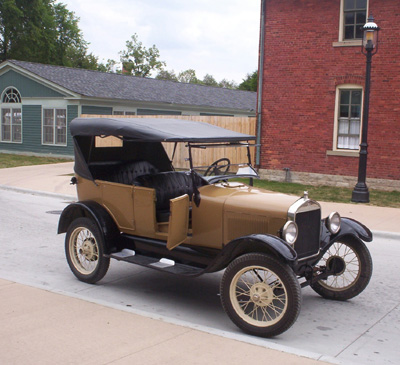
Ford Model T, 1927, regarded as the first affordable automobileSince the 1920s, nearly all cars have been mass-produced to meet market needs, so marketing plans have often heavily influenced automobile design. It was Alfred P. Sloan who established the idea of different makes of cars produced by one company, so buyers could "move up" as their fortunes improved. The makes shared parts with one another so larger production volume resulted in lower costs for each price range. For example, in the 1950s, Chevrolet shared hood, doors, roof, and windows with Pontiac; the LaSalle of the 1930s, sold by Cadillac, used cheaper mechanical parts made by the Oldsmobile division.


References Data and Images


Design Car


The design of modern cars is typically handled by a large team of designers and engineers from many different disciplines. As part of the product development effort the team of designers will work closely with teams of design engineers responsible for all aspects of the vehicle. These engineering teams include: chassis, body and trim, powertrain, electrical and production. The design team under the leadership of the design director will typically comprise of an exterior designer, an interior designer (usually referred to as stylists), and a color and materials designer. A few other designers will be involved in detail design of both exterior and interior. For example, a designer might be tasked with designing the rear light clusters or the steering wheel. The color and materials designer will work closely with the exterior and interior designers in developing exterior color paints, interior colors, fabrics, leathers, carpet, wood trim, and so on.
In 1924 the American national automobile market began reaching saturation. To maintain unit sales, General Motors instituted annual model-year design changes (also credited to Alfred Sloan) in order to convince car owners they needed a replacement each year. Since 1935 automotive form has been driven more by consumer expectations than engineering improvement.
There have been many efforts to innovate automobile design funded by the NHTSA, including the work of the NavLab group at Carnegie Mellon University.Recent efforts include the highly publicized DARPA Grand Challenge race.Acceleration, braking, and measures of turning or agility vary widely between different makes and models of automobile. The automotive publication industry has developed around these performance measures as a way to quantify and qualify the characteristics of a particular vehicle. See quarter mile and 0 to 60 mph.

References Data and Images